In the spring of 2010, my email box was inundated with writers looking for the softer side of the story of the Deepwater Horizon explosion and following oil spill disaster. These seekers of a different angle flocked to my bayou to interview my shrimping neighbors. As a wetland advocate, I wondered how I could use this man-made disaster as a platform to further the cause of education and awareness.
It became clear to me early on that most of the journalists who arrived at my door really had no clue about our culture and way of life. So, if they wanted a story about how the oil spill had impacted us, then they must humor me and allow me to educate them about this vanishing ecosystem and its people.
What these well-meaning journalists needed first was a foundational perspective from the standpoint of a population of coastal communities who were suffering yet one more blow to their way of life. As a woman who lives, works, and fishes here, I could give them that perspective, which was simply this:
This oil spill was not an isolated disaster for the people of coastal Louisiana. It was like being kicked when we were already down. And here’s why.

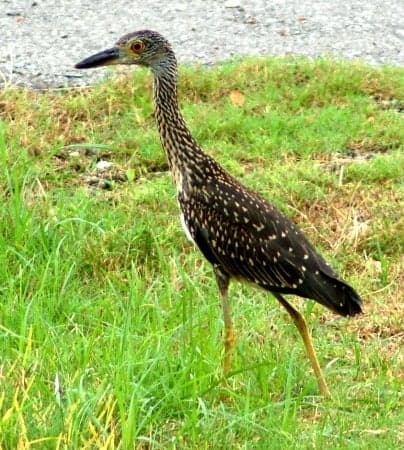



Ah, you took all the fun out of it for me! 🙂 I won’t say a thing. Hope you had fun working.
You could have had fun like Stephanie! She got really creative with her idea of what this is! Sorry, I knew you would know, so I headed you off beforehand!
Your ‘mystery Bird” is the elusive Spotted Cocodrie Cajun Crustacean Catcher . These birds are trained (by Cajuns) to seek out “crawfish mud huts”, so the cajuns will know where to put their crawfish traps. If the bird is not a good hunter,and doesn’t “produce” they are plucked, deep fried, and eaten. (Cajuns don’t waste anything)
P.S.
I’m told they taste like chicken. This is also the reason this bird is on the endangered species list.
What a hoot, Steph!! I can’t do better!!! I was gonna say the bird is a green heron – but what do I know!
JoanS
No, it’s not a green heron! But that’s a good guess!
Looks like the rare Speckled Brown Bayou Chicken Legged Crawdad Flamingo. I’ve only seen one other one and it tasted like armadillo. One key is that you will never find one within 100 miles of a young Yellow Crowned Night Heron. They are natural enemies and do not share habitat. So, if there are any Night Herons around it might not be a Crawdad Flamingo. The way the knees bend could also be a clue.
Oh my gosh! Y’all are amazing! Stephanie, I do believe you should be a fiction writer! Are you a fiction writer? LOL! And Pete, welcome to the bayou and I love your name for the bird, also!
I’ll let this go for the night and post updates on Monday, if possible!
Thanks for the responses, all!
BW
Long neck, poka dot, crawdad catcher.
I love it!
That is a crawdaddy egret. He looks young and skinny too ! I wish I was that skinny !!
Another good one, Doris!
Well, since you haven’t update yet, here’s my guess. It’s a speckled-back, knock-kneed, mudbug muncher!
ROTFL!!!!
It’s the seldom seen Long-legged-whysmy-headsofreakin’-big? in it’s natural habitat: a Studabaker.
Oh my gosh, Emilie! You definitely need a vacation! When you coming down?
Enjoy you comments. I think it’s a centeral Amer. Tiger Heron blown off course by the hurricans.
I’m not sure what it is, but most cajuns will probably eat it!
I don’t know but one is on my fence in Georgia right now starring at my dog. So what is it ?
Hi Luther and welcome! This is a juvenile coastal wading bird of the night heron variety. It is a juvenile, I think. Don’t typically sit on fences, though! A pic would help me ID for you!